

Every company tries to tell a story to sell their products, and yet very few seem to reach cultural momentum. What if they just needed to learn from what once worked?
Ads seem to be inevitable today. They stand at every corner of the streets and the internet, shouting at us to buy the latest product on the market.
Even streaming services, once built on the promise of unlimited content without unwelcome interruption, are now fully shifting to ad-supported offers, and given the numbers they add from those plans, they won’t back down anytime soon.
Everything is loud and noisy, and nothing means anything. Which made me question something:
What’s the last time we felt captivated by a product? When something came out of nowhere, promising to radically change our lives for the better?
I’m so over ads that I can’t remember anything striking over the last decade. But I do remember the first time a product struck me.
When I first saw a billboard for the iPod in 2001.
I just stared with curiosity at this all-white board, where what looked like a remote straight out of an episode of The Jetsons towered over me. I couldn’t take my eyes off it.
But the words below were even more striking.
The promise? "1,000 songs in your pocket." A THOUSAND.
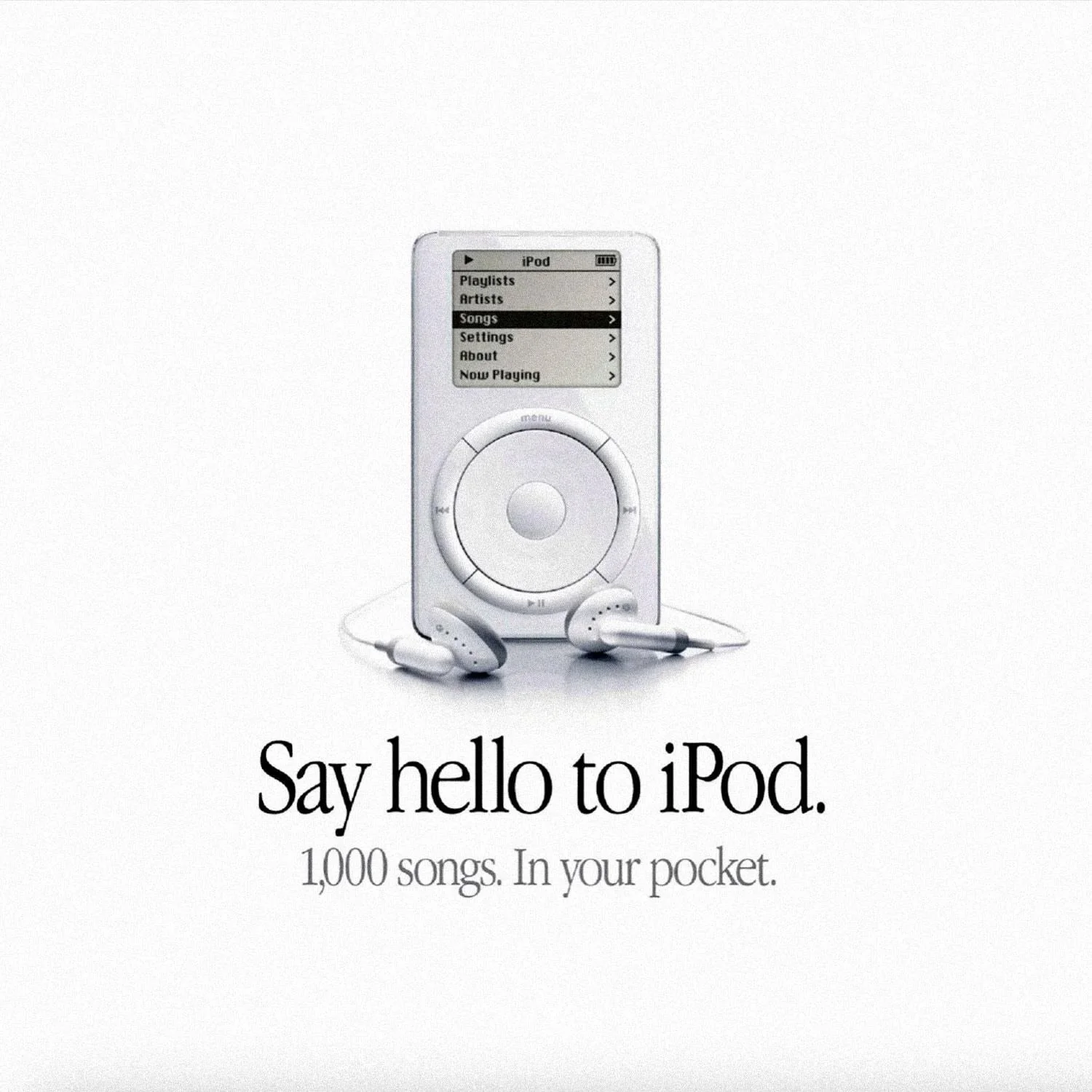
To put it in perspective, MP3 players weren’t readily available then: CDs were still the top format for listening to music. And most players could barely hold a dozen songs. A thousand seemed like an impossible promise.
And yet, it worked. iPods flooded the market over the years, becoming the ultimate reference for listening to music anytime, anywhere.
Just with a promise of a thousand songs.
No flashy commercials, no loud announcement on TV or radio every 5 minutes. Just a simple, soft, intimate — almost whispering — sentence.
When products tell Stories
Looking back, it wasn’t the gadget that hooked me: it was the feeling. The sense that someone understood what I needed before I did.
Apple has been celebrated since its creation for pushing innovation and making computers more socially acceptable: simple interfaces, welcoming designs, and ease of use in everyday life. Personal computer, iPod, iPhone, iPad… They’re not only products, they’re part of a story.
The one that Steve Jobs wanted to tell.
Nearly 15 years after his passing, why is Steve Jobs still considered one of the most innovative people of the last century? His rise in the computer industry seems at odds with his skills: he never wrote a line of code, or probably solder a single microchip. He wasn’t an engineer, or an analyst, or a businessman. But he had an ability that too many business leaders still lack:
Storytelling.
The idea behind Apple wasn’t just to make and sell computers: it was to make them socially acceptable to the global audience. At a time when computers still looked like cold military machines and could process less data than a children’s calculator today, this was considered at best revolutionary and at worst delusional.
Yet Jobs persisted in his vision, and Apple produced some of the most imaginative corporate storytelling of the 20th century. The now-legendary 1984 Super Bowl ad, directed by Ridley Scott, used Orwell’s imagery to frame Apple’s vision for how computers should be used: rebellion, individuality, the human spirit versus the machine. That single ad didn’t just introduce a product: it introduced a worldview.
Cut to nearly 50 years later, and everyone has a computer in their pocket. Everyone has access to the world's knowledge at their fingertips. Everyone can connect with anyone, anytime, anywhere in the world, without hesitation.
Jobs didn’t just sell machines; he sold a vision of how people could see themselves using them.
His understanding of storytelling didn’t stop with Apple, though. He transformed the Animation division of Lucasfilm into Pixar Studios, whose films, such as Toy Story, Monsters Inc., and Finding Nemo, made groundbreaking use of computer graphics in movies and earned critical and public acclaim for their focus on heartfelt, universal storytelling.
In a way, we’re still living in the world Steve Jobs imagined.
Storytelling Beyond the Sales
Many companies tried to use that model and marketing to create a sense of belonging among their customers. Few succeeded. Unlike Cupertino’s firm, their strategies seem to lack something. Something that makes most messages hollow and fake: a vision worth sharing.
Companies enjoy showing their new products and their vision, but don’t allow the public to appropriate the story for themselves. And yet that’s storytelling's most powerful tool: immersing the audience in the message and letting them appropriate the product or service because they feel it is part of themselves.
Right now, every Tech company tries to force AI into their services, promising it will facilitate customers’ everyday lives. But what they actually do is talk to themselves and their investors, not the audience.
Because we live in such an interconnected world, our attention is worth more than any other currency. If you’ve visited YouTube over the years, you’ve probably been startled more than once when your quiet playlist was interrupted by an umpteenth ad about a new payment service.
The messages aren’t subtle or inviting; they’re loud and intimidating. It’s not a friend quietly telling us about a secret party they were in; it’s a school teacher yelling at us to use the proper tool in their class. Every product is shoved in our faces without any space to breathe or think.
Think back to the Macintosh ad: no image of the computer. Not one. People were simply invited to imagine what the future could look like.
Because Jobs didn’t just market stories: he built machines that told them. At Apple, those machines were sleek rectangles. At Pixar, they were lamps, toys, and robots with hearts.
Reclaiming the Narrative
Good corporate storytelling doesn’t shout. It listens first, then answers with meaning. Apple didn’t tell us what to buy — it told us who we could be. That’s not advertising. That’s storytelling.
That’s what I want to help you with your message. Every brand should be able to rediscover its voice and share it so the rest of the world can have a dialogue with it.
Because in the end, stories don’t belong to companies. They belong to people.
And maybe, just maybe, it’s time we start telling them that way again.