

Brevo vs Mailjet: Which email platform is best for SaaS companies?

Newsletters are a fantastic way for a business to get in touch with its audience, nurture leads and drive conversions. A good newsletter can do all of these things.
Connecting with users: regular communication goes a long way to in maintaining a relationship with your subscribers.
Promoting features: Newsletters can be used to highlight new features or updates and thereby encourage users to go and have a look.
Deliver valuable content: sharing your insights, tips and educational content will keep your users informed and engaged.
Because of the nature of their activity, SaaS businesses have different email requirements than traditional businesses. Among them:
Transactional emails such as password resets, account notifications and billing confirmations.
Marketing emails, onboarding sequences and product announcements.
Automated lifecycle campaigns to improve activation, retention and engagement.
Integration with existing products, CRMs and analytics tools.
Brevo and Mailjet are the two European email platforms that offer both marketing and transactional email. They're both good options but they're very much suited to different types of company.
In this guide, you pick the platform that's right for your technical needs, your marketing approach, and your budget.
Brevo vs Mailjet: What's the difference?
Brevo and Mailjet are both essentially the same thing really, they're both platforms that allow you to send out newsletters. They enable a SaaS business to measure the success of its newsletters by looking at the key metrics of open rate, click through rate, conversion rate and subscriber growth.
Brevo is a much broader customer engagement platform. It's essentially an all-in-one platform for customer engagement which can be used to run campaigns, track deals, and text customers, as well as a whole host of other things without you having to pile up a raft of different tools.
Mailjet is more aimed at the developer/product team who want clear transactional email and team collaboration on the templates. You get an email API and SMTP relay for your transactional email, a drag-and-drop editor, and on the Premium plan you get the team features: multi-user collaboration on templates, roles, and permissions. Based in Paris, they state that their data centers are all EU-based and they hold ISO 27001 for GDPR.
Here’s a brief comparison of both platforms and their specificities:
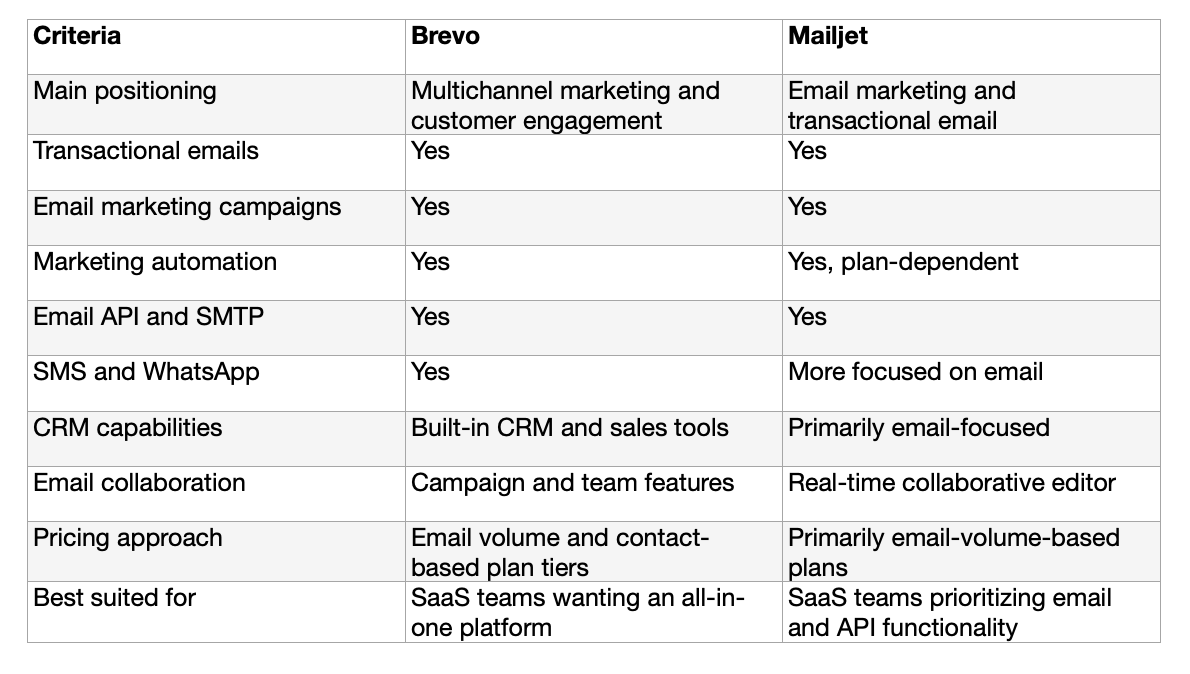
Brevo is more likely to be the solution for a small to midsize business that wants a range of communication tools all in one place. Mailjet is more focused on email campaigns and creative collaboration around email.
The choice really comes down to whether your SaaS business needs a broader marketing ecosystem or a more targeted email solution.
Feature-by-feature comparison: Brevo vs Mailjet for SaaS
Transactional email Capabilities and Deliverability
There's nothing worse than putting together a really well-crafted newsletter only to have it go straight to spam. Deliverability features on a platform are absolutely vital to ensure your emails actually get into the inbox rather than being filtered out.
They focus on reliable, high-speed delivery of user-triggered messages like password resets and order confirmations, with key features including:
Transactional email API and SMTP relay.
Sending of password resets, verification codes, invoices and usage notifications.
Dynamic email templates and personalisation.
Real-time delivery tracking, bounce management and webhooks.
Deliverability monitoring and dedicated IP's.
Brevo
Brevo supports transactional email via its API and SMTP relay. It has a single unified API which covers email as well as other communication channels (WhatsApp, social media etc). It offers transactional messaging as well as marketing and CRM. That means a small business that needs both transactional and marketing email can put everything on one platform.
Mailjet
Mailjet also has transactional email via its Email API and SMTP relay. Given that it's a mail focused product it also provides webhooks, event tracking and dynamic templates. It's therefore very much the product of choice for developer type businesses who want to build their own email solution.
Takeaway:
Brevo is all about making it easier to manage product triggered emails and marketing communications without introducing any undue technical complexity. Mailjet is the better option for those who want the maximum flexibility with their newsletter strategy and don't necessarily need the other channels.
Marketing Automation and Customer Lifecycle Management
Unlike a standard newsletter, marketing automation actually automates the process and can then target specific audience segments via triggered workflows, using behavioural data and dynamic content to deliver the right message to the right person at the right time. The end result is increased engagement and increased revenue.
Key features:
Automated onboarding and welcome sequences.
Behavioral triggers and segmentation.
Trial expiry and upgrade reminders.
Re-engagement & churn prevention campaigns.
A/B testing and campaign analytics.
Brevo
The platform provides marketing automation based on customer behaviour and a range of pre-defined triggers. It also has a good amount of CRM and customer engagement functionality which is very useful for a team that is running a number of lifecycle campaigns.
Mailjet
Unlike Brevo, Mailjet only offers marketing automation in its Premium plan. It does offer segmentation, personalisation and campaign management so it's aimed at helping teams to create and manage their email communications in a collaborative way.
Takeaway:
If customer lifecycle automation is your key consideration then Brevo is clearly the winner on the automation front and with multi-channel capability. Mailjet has some automation capability but it's fairly basic and it does have a very good deliverability score which is obviously a major consideration if your whole game is email.
API, Integrations, and Developer Experience
An API is key to integrating the comms tools and getting the newsletters out.
Key features:
REST API and SMTP integration.
SDK availability and documentation.
Webhooks and event tracking.
Integration with CRMs, product databases and analytics tools.
Easy to implement and easy to maintain going forward.
Brevo
Since the whole point of the communication tools integration is the platform, it makes perfect sense that Brevo has a single unified REST API for email, SMS, WhatsApp, contacts and events. The webhook supports real-time event notifications for payment activity, which will appeal to those teams looking to have multiple communication channels under one integration.
Mailjet
All focused on the email integration experience, the platform has developer resources as well as its Email API, SMTP relay and webhooks to help teams run their campaigns and transactional messages through a single workflow. It has a volume-based plan which gives developers more headroom to grow without any increase in contact cost.
Takeaway:
Mailjet is the one that's favored by teams who want an integrated suite of email optimization services. Brevo is the one that's preferred by teams who want all their communication channels on one platform so they can manage a variety of campaigns from a single interface.
Before you go for your platform, have the dev team look at the API documentation, the amount of work involved in implementation, event tracking and how well the platform integrates with the existing tech stack.
For example, check if the platform offers pre-built integrations with major SaaS tools like Salesforce, HubSpot, or Slack, or if it provides easy ways to connect with your CRM, customer database, or analytics stack. This could include direct connectors, Zapier integrations, or custom REST API hooks depending on your team's needs. The smoother the integration with your main SaaS systems, the less friction you'll face during deployment.
Collaboration and Campaign Creation
Email collaboration tools take the traditional email platform and add in a whole host of features to assist with working in a team. You can have shared inboxes, you can assign tasks and you can actually talk to each other in the email thread.
Key features:
Drag-and-drop email editors.
Reusable templates.
Dynamic content and personalization.
Team access and collaboration.
Approval workflows and brand consistency.
Brevo
With real time collaborative editing you can have teams designing emails using a huge range of templates, no design skills required at all. They also claim a 99% delivery rate which is obviously vital to not end up in the spam folder.
Mailjet
Mailjet's drag and drop editor is its key feature. You get an email editor very much in the Google Docs style which enables you to move the whole process along and keep brand consistency. There's a manager approval step before any newsletters are sent.
Takeaway:
Mailjet may be the more appealing option in the case of a team where marketers and designers are working together on email. Brevo on the other hand may be the more attractive proposition if your email campaigns are part of a broader customer engagement strategy.
Brevo vs Mailjet pricing: which offers better value for SaaS companies?
Of course the choice isn't just down to features and capabilities. Price is an important factor when you're choosing the right newsletter platform. The sensible thing to do is however to look at the options in terms of how you actually use them.
The good news is that both Brevo and Mailjet have a free plan which is very capable. Mailjet's free plan allows up to 6,000 emails per month, with a daily limit of 200 emails and 1,000 contacts. Brevo's free plan is slightly better in that it allows up to 300 emails per day and 100,000 contacts which is a bit more generous for a small business that wants to get out to a wider audience.
For the paid plans both offer an entry level plan at $9/month (8k emails/month for Mailjet, 5k for Brevo). Each of the paid plans has different contact allowances, sending volumes and features.
Here’s a comparison table to summarize the price differences:
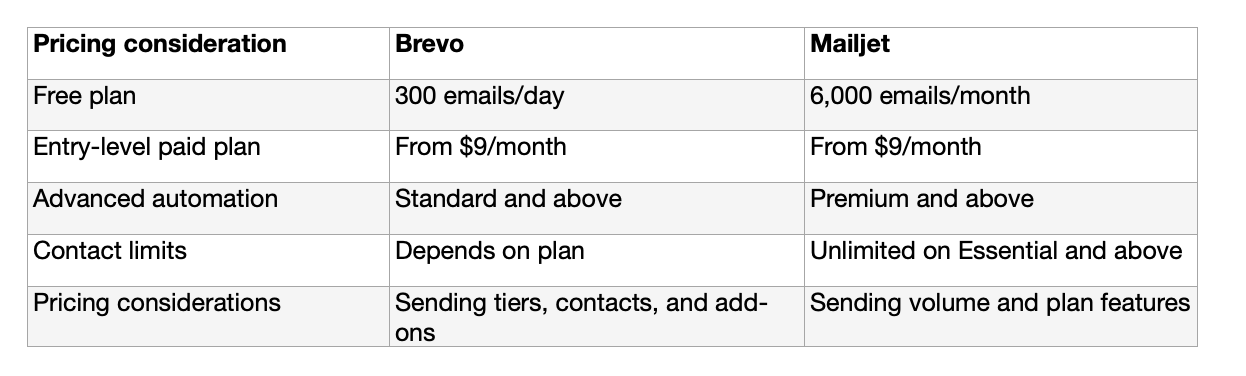
Overall, SaaS managers should calculate the following before choosing a plan:
Monthly transactional email volume.
Marketing email volume.
Number of stored contacts.
Number of marketing users.
Features that require the higher tier subscriptions.
Additional costs for dedicated IPs, branding removal etc.
Takeaway:
Brevo may be the better proposition if you're a SaaS business that needs multiple communication channels as well as CRM. Mailjet may be the simpler option if all you really need is email sending.
Which platform should your SaaS company be on?
Mailjet and Brevo are two of the more popular options for SaaS companies that are looking to send out email campaigns. They're both very solid newsletter services, offering a range of templates and collaborative tools at a reasonable price point.
That said, each has its own merits to consider prior to making a decision.
Choose Brevo if...
You need email, SMS and WhatsApp all in one platform.
Marketing automation and lifecycle campaigns are key to your growth strategy.
You want built in CRM and sales functionality.
Your marketing team need a wider customer engagement environment.
You want to consolidate a number of marketing tools.
Choose Mailjet if...
Your main requirement is marketing and transactional email.
Your devs need API and SMTP functionality.
You want to do collaborative email drafting between team members.
You want pricing based on volume of email you send.
You'd rather have a more focused email platform than a broad CRM environment.
Before you commit, test both platforms with your real email workflows. Compare the API implementation, the automation setup, the deliverability reporting and the total monthly cost at your expected sending volume.
Ready to choose your SaaS email platform? Compare Brevo and Mailjet's current plans, test the features that matter most to your team, and select the solution that can scale alongside your product.